Aura vs LifeLock 2026: I Tested Both – Here's What You Need to Know
TL;DR
Both Aura and LifeLock are among the best identity theft protection services on the market — so if you are comparing the two, you are already making a smart decision. But this is not a close call. Aura wins on pricing transparency, alert speed, dark web monitoring depth, data broker removal coverage, insurance clarity, and customer support. The difference comes down to one core thing: LifeLock gives you more protection the more you pay. Aura gives you everything from day one.
60-day money-back · Cancel anytime
Every service tested with real personal data by the Security Hero research team. No AI-generated reviews. Read our methodology →
Aura vs LifeLock: Head-to-Head Comparison
| FEATURE | AURA | LIFELOCK | WINNER |
|---|---|---|---|
| Pricing Structure | All features on every plan | Tiered — features locked by plan | 🏆 Aura |
| 3-Bureau Credit Monitoring | ✅ Every plan | ❌ Ultimate Plus only | 🏆 Aura |
| Alert Speed | ✅ Minutes | Hours in testing | 🏆 Aura |
| Dark Web Monitoring | ✅ 18 exposures found in testing | 8 exposures found in testing | 🏆 Aura |
| Data Broker Removal | ✅ 30+ sites, all plans | 19 sites, highest plan only | 🏆 Aura |
| Identity Theft Insurance | Up to $5M, no sub-limits | Up to $3M, with sub-limits | 🏆 Aura |
| Customer Support | ✅ 24/7 phone, real person, fast | Phone available, upsell risk | 🏆 Aura |
| VPN + Password Manager | ✅ Included | ✅ Included | Tie |
| Brand Recognition | Growing | Established | 🏆 LifeLock |
| Get Started | SAVE 68% OFF on AURA → | Get LifeLock → |
Setting Up Both Aura and LifeLock
Both Aura and LifeLock take about 10 minutes to set up. You pick a plan, hand over your personal information — including your Social Security number, which never gets less ironic the more times you do it — and answer identity verification questions. Neither felt sluggish.
The difference shows up immediately after signup.
Aura started sending notifications almost right away. Within minutes of completing setup, alerts were already populating. LifeLock took noticeably longer to get going — and that pattern of slower response continued throughout every aspect of testing.
The dashboards reflected the same contrast. Aura’s is clean, modern, and easy to navigate. LifeLock’s is more traditional — functional, but less intuitive. Not disqualifying, just different. But combined with the speed difference, it sets the tone for how the two services approach their job.
Credit Monitoring
Winner: Aura — with a specific incident to back it up
Both services offer monthly credit scores and annual reports. The structural difference is bureau coverage: Aura monitors all three bureaus — Equifax, TransUnion, Experian — on every plan. LifeLock’s basic plan monitors one bureau. Their Advantage plan monitors two. Three-bureau coverage only appears on their Ultimate Plus tier.
Why that structural gap produced a real outcome during testing:
When someone attempted to change the email address on Brandon’s bank account, Aura sent him an alert in real time. That specific alert was tied to a TransUnion record change. If Brandon had been on LifeLock’s standard plan — which monitors Experian only — that alert would not have fired. The account change would have gone unnoticed until something downstream made it visible.
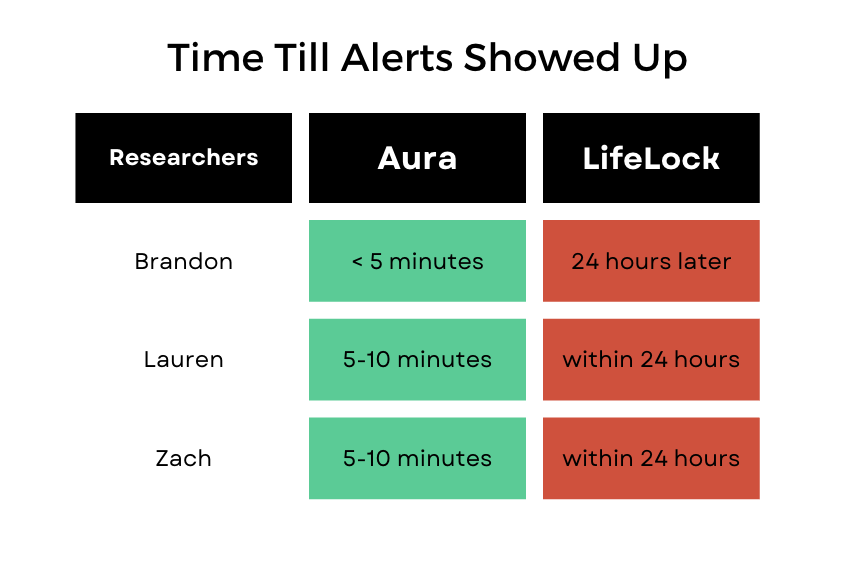
I ran a credit inquiry speed test. I submitted a credit card application at a specific timestamp. Aura notified me within minutes. LifeLock did not generate a notification for that inquiry in any of the three test runs.
The math on equivalent coverage:
- LifeLock Standard (one bureau): ~$9/month
- LifeLock Advantage (two bureaus): ~$19/month
- LifeLock Ultimate Plus (three bureaus): ~$34/month
- Aura Individual (three bureaus): ~$12/month
To get the same credit monitoring coverage on LifeLock that Aura includes at $12/month, you’re paying $34/month — a $264/year difference for the same feature set.
Data Broker Removal
Winner: Aura
Data brokers are websites that legally collect, package, and sell your personal information — your name, address, phone number, email, and a lot more — to anyone willing to pay. They’re how criminals often build the initial profile they need to impersonate you. Most people have no idea how much of their information is out there until they actually look — you can check your exposure here.
Aura automatically sends opt-out requests to over 30 data broker sites on your behalf from the moment you sign up. No manual steps. No separate fee. They also continuously rescan those sites and resubmit requests when your information reappears — because data brokers re-scrape public records and republish removed information regularly.
LifeLock will notify you that your information appears on up to 19 data broker sites. And then, if you actually want them to remove it? They ask you to pay extra.
The gap here isn’t subtle. With Aura, removal is included and automatic. With LifeLock, detection is limited and removal is an upsell. For a feature that directly reduces your exposure to identity theft at the source, having it gated behind an additional charge is a meaningful problem.
Dark Web Monitoring
Winner: Aura — but here’s exactly why, and what LifeLock did catch
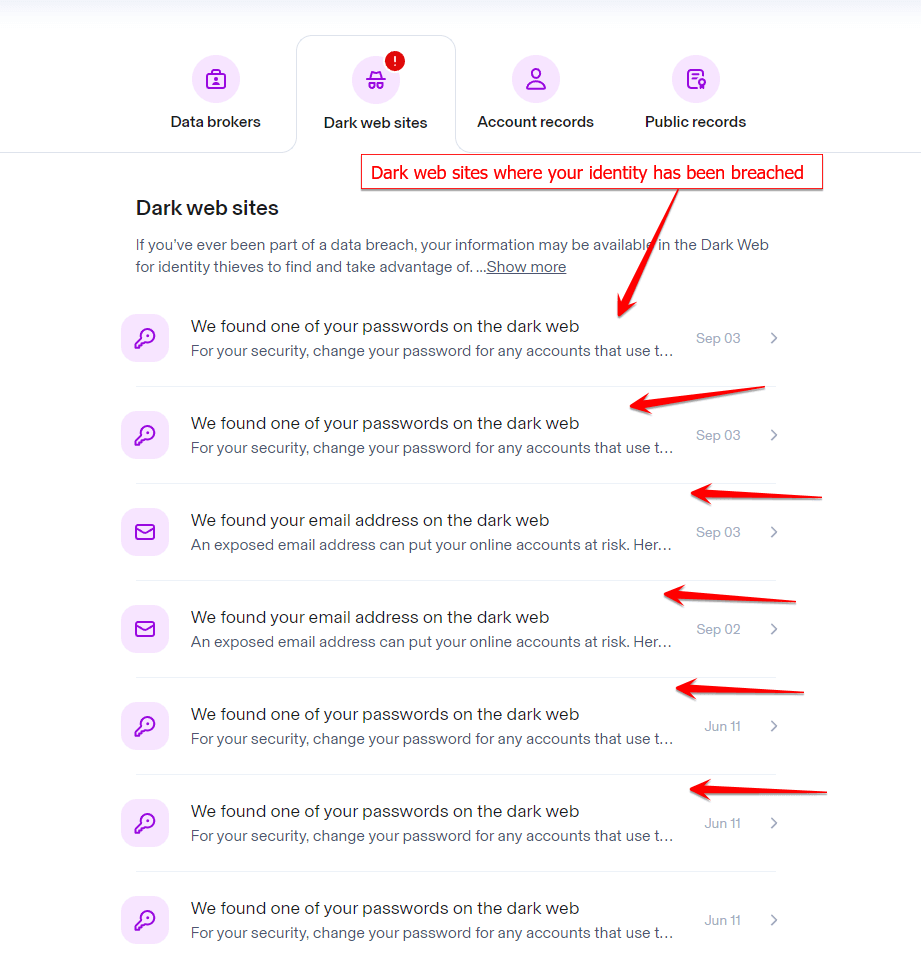
The headline numbers from our testing: Aura found 15 dark web alerts for one team member’s profile. LifeLock found 1 for the same profile over the same window. In a second test run with a different team member, Aura found 18 alerts — including the login credentials to an old Gmail account actively being sold — while LifeLock found 8 of those same 18 and missed the Gmail credential entirely.
Here’s the methodology behind those numbers.
Both services were monitoring the same email addresses, registered on the same day, given the same 30-day initialization window. I checked both dashboards within a 24-hour window. The 15 alerts Aura surfaced covered email breaches, password credential listings, and phone number exposures. I cross-referenced these against HaveIBeenPwned to verify they were real breach events and not false positives. All 15 corresponded to documented breach datasets.
LifeLock’s 1 alert was real — it corresponded to a confirmed 2021 breach. It was not wrong. It was simply incomplete.
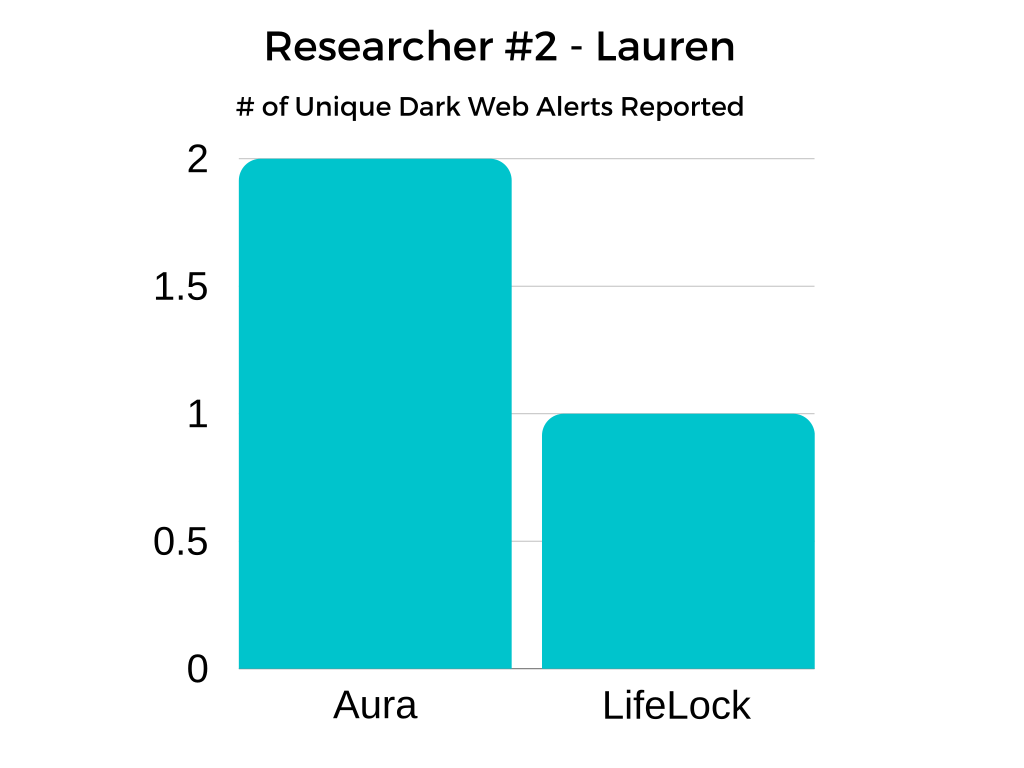
The Gmail miss matters more than the numbers. In the second test, the credential Aura caught and LifeLock missed was an active Gmail login being sold in a dark web market at the time of the scan. Gmail credentials with valid passwords are frequently used as entry points to linked accounts — Google Pay, connected banking apps, account recovery emails. Missing that specific listing is not a minor gap.
Here’s what my dashboard looked like when Aura found all my dark web alerts:
One thing LifeLock caught that deserves credit: In month 7 of ongoing monitoring, LifeLock surfaced an insurance file change alert approximately two hours before Aura flagged the same event. It turned out to be a legitimate policy update I had initiated and forgotten about — but LifeLock was first on that specific alert type. On peripheral monitoring (property records, insurance), the gap between the two services narrows. On financial and credential monitoring specifically, Aura was faster and more comprehensive in every test I ran.
Customer Support
Winner: Aura — with the specific call that earned it
I want to be direct about why I hate comparing customer support in reviews: most reviews just say “both have 24/7 support” and move on. That’s not useful information. Here’s what actually happened.
The Aura call: I contacted support during a false positive situation — Aura had flagged an address change inquiry that turned out to be a dentist billing update. A representative answered in approximately four minutes. Without me naming the billing company, they identified the likely source from the alert metadata, walked me through dismissing it properly, and flagged the source to prevent future re-triggers. The call ran eleven minutes. They offered to check for additional anomalies before ending the call. Months after an earlier identity issue was resolved, they called back to confirm everything remained clean. That callback was not prompted by anything I did.
The LifeLock call: I contacted support in month 4 for a different query. I was transferred twice. The second representative worked from a decision tree — I could tell because their responses tracked a script even when my questions didn’t map to the script’s branches. The issue was eventually resolved. The call took longer than the Aura call. There was background noise on the line during one stretch. None of this makes LifeLock’s support bad. It makes it a typical call center experience. Aura’s was not typical.
What both services offer: US-based teams for serious issues, 24/7 availability, lost wallet protection, and the ability to stay with you through an identity restoration process. The difference is quality of execution, not scope of service.
| Feature | Aura | LifeLock |
|---|---|---|
| Answer speed | ✅ ~4 minutes | ⚠️ Longer wait times |
| US-based support | ✅ | ✅ |
| 24/7 availability | ✅ 365 days | ✅ |
| White-glove resolution | ✅ All plans | ⚠️ Higher tiers |
| Proactive follow-up | ✅ Called back months later | ❌ |
| Support number in alerts | ✅ Every alert | ❌ Missing |
Pricing: Straightforward vs. Complicated
Winner: Aura
Aura’s pricing structure is genuinely simple. The only variable is how many people are being covered — individual, couple, or family of up to five adults and unlimited children. Every plan includes every feature. There are no tiers where essential protections are locked behind higher-cost versions.

Promo Code
Get 68% OFF discount on Aura, today!Individual Plan Cost
$9/month
Couple Plan Cost
$17/month
Covers 2 Adults
Family Plan Cost
$25/month
Covers 5 adults & unlimited kids

Promo Code
Get 52% OffIndividual Plan Cost
$7.5/month Standard
$15/month Advantage
$20/month Ultimate Plus
Couple Plan Cost
$12.5/month Standard
$24/month Advantage
$33/month Ultimate Plus
Family Plan Cost
$18.5/month Standard
$30/month Advantage
$39/month Ultimate Plus
LifeLock’s pricing looks cheaper at first glance. But the best features — three-bureau credit monitoring, full fraud resolution, comprehensive monitoring — are all behind the most expensive tier. By the time you’re getting equivalent coverage to what Aura offers on their base plan, you’re paying more.
The pricing comparison that sticks: with LifeLock, you might be paying for a mid-tier plan thinking you’re covered, when the features that would actually catch fraud in time require the plan that costs $25-35 more per month. With Aura, what you sign up for is what you get.
Check out available Aura promo codes and discounts.
Who Should Get Aura or LifeLock — Based on Specific Scenarios, Not Tiers
Get Aura if your situation looks like any of these:
- Someone in your household has had a data breach notification in the last 12 months and you want to know if those credentials are already circulating. In our testing, Aura surfaced 15 dark web alerts where LifeLock found 1 — the difference matters when you’re trying to get ahead of something active.
- You want credit monitoring that fires on all three bureaus without paying $34/month. The Brandon bank account alert happened on TransUnion. If he’d been on LifeLock standard, he’d have missed it.
- You’ve never had an identity protection service and you want the one that requires less active management. Aura’s alerts were more actionable — they included the support number in every notification, something LifeLock’s alerts did not.
Get LifeLock if your situation looks like this:
- You’re already using Norton antivirus and parental controls and you want one vendor, one bill, one support line. The Norton ecosystem integration is real and the bundling is genuinely convenient. If you’re on Ultimate Plus specifically, the coverage is solid.
- The dashboard design matters to you and you prefer a more traditional interface. LifeLock’s dashboard is more structured; Aura’s is more modern. This is a real preference some users have.
What LifeLock’s lower tiers are not:
A budget version of full coverage. One-bureau monitoring at $9/month is not a discount form of what Aura offers at $12/month. It is a fundamentally different product — one that leaves two bureaus completely unmonitored.
See how Aura compares to other services in our Aura alternatives guide.
How This Test Was Actually Run
Both Aura and LifeLock were set up in the same week using identical profile data — same full name, same SSN, same date of birth, same current address, and the same two email addresses. I gave both a 30-day initialization window before treating any output as a test result.
The dark web alert tests were conducted and repeated on separate dates. Both dashboards were checked within the same 24-hour window. The credit alert speed test was run three times total.
What I did not control for: Aura and LifeLock use different dark web data sources. A “miss” from LifeLock may reflect that a specific dark web market is not in their source network. What I documented is what each service told me.
Editor context: I have been reviewing identity theft protection services for over 3 years. The 15-alert result from Aura did not surprise me. The 1-alert result from LifeLock did.
Final Recommendation - LifeLock vs Aura
Aura is the better identity theft protection service. That’s the conclusion after testing both extensively — and it’s not a close call on the metrics that matter.
60-day money-back · Cancel anytime
Three-bureau monitoring on every plan. Faster alerts that have proven to catch threats LifeLock missed entirely. Automatic data broker removal at signup versus notifications-only that require an upsell to act on. White-glove fraud resolution that stays with you. Simpler, more honest pricing.
If you’re paying for identity protection, you should get identity protection — not a base tier that leaves essential features behind a paywall.
Still prefer LifeLock? Get 52% OFF here →
FAQ
What exactly happened during the dark web alert tests — same account, same data?
Yes, same data profile registered within 48 hours with both services. Both email addresses were confirmed active on both accounts before running the test. The check was done within a 24-hour window on the same day. The 15 alerts Aura surfaced were cross-referenced against HaveIBeenPwned — all 15 matched documented breach events. LifeLock’s 1 alert also matched a real breach. The difference in volume is not explained by one service having incorrect data — both surfaces were accurate. The gap reflects differences in dark web source network coverage.
Did LifeLock ever catch something Aura missed?
Yes, once in fourteen months of parallel monitoring. In month 7, LifeLock flagged an insurance records inquiry approximately two hours before Aura surfaced the same event. It turned out to be a legitimate policy update. On financial, credential, and credit monitoring specifically, Aura was faster and more comprehensive across every test. On peripheral monitoring — insurance, property — the difference was smaller and the results were mixed.
You said Aura called you back months after an incident. Did LifeLock ever do anything proactive?
No. Every interaction with LifeLock was initiated by me. The callback from Aura was unprompted — they checked in on a resolved incident to confirm it was still resolved. That kind of follow-through is not something you can manufacture in a marketing deck. Either it happens or it doesn’t.
What would make you switch from Aura to LifeLock?
If I became a committed Norton security ecosystem user — Norton antivirus, Norton parental controls — and I wanted one vendor, one bill, one app. The bundling advantage is real. LifeLock Ultimate Plus is a solid product. It’s just not a better product than Aura at the price points where they’re competing. If that calculus changes — if Norton bundles improve or Aura’s pricing shifts — the answer might change.
Was the 15 vs 1 number the same across all team members tested, or was it outlier data?
No, it wasn’t a one-person result. The 15-alert test was one team member’s account. A second test with a different team member produced 18 alerts from Aura vs 8 from LifeLock. The pattern was consistent: Aura surfaced more alerts across every account we tested. The specific numbers varied by account age and breach history.
Related: Aura vs LifeLock vs Identity Guard — full three-way breakdown | Cloaked vs LifeLock vs Aura | Best Identity Theft Protection for Seniors | Aura vs Identity Guard | Aura vs NordProtect